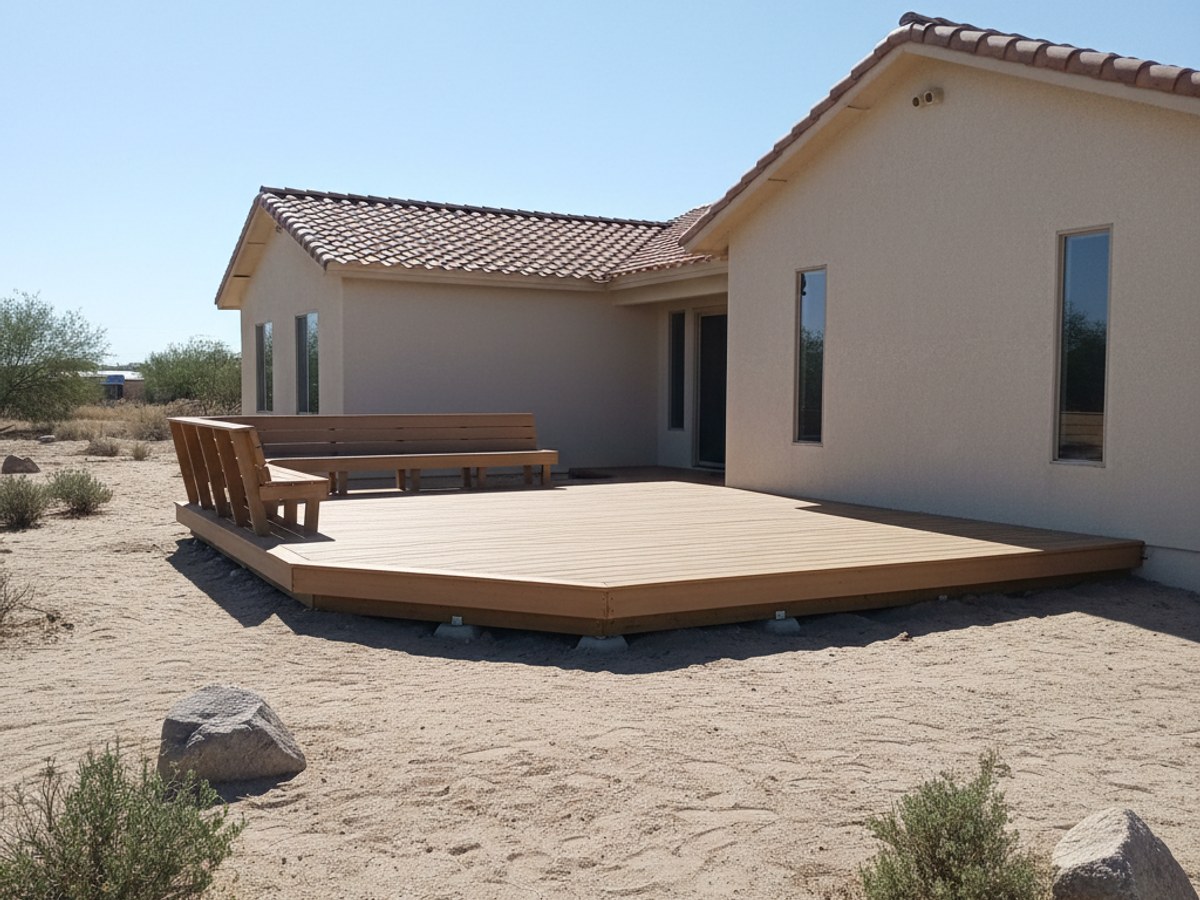
Ask five deck builders in the valley when to schedule a build and you'll get five different answers, mostly because they're thinking about their own crew calendar instead of what the ground and the sky are actually doing. Henderson has a narrow set of windows where concrete cures the way it's supposed to, stain dries before it gets rained on or baked off, and lumber doesn't move on you before the screws go in. It's not random.
What the heat actually does to a deck build
From June through August, Henderson regularly sits at 105 to 110°F in the afternoon. That's brutal for two specific steps. First, footing concrete. A standard mix needs to stay damp and above 50°F to cure at the right rate, and it hits maybe 70% of its strength in the first week. In dry desert heat, water flashes out of the top of a pour in hours if you don't cover it or use a curing compound, and you end up with a footing that's strong on the inside and crumbly on the surface. Second, stain and sealer. Most exterior stains want a surface under 90°F and at least 24 to 48 hours without rain to cure properly. On a July afternoon the decking itself can hit 150°F or more in direct sun, and the stain skins over before it soaks in. You get a film that peels within a season instead of a finish that lasts three or four years.
Composite decking has its own heat problem. It expands and contracts more than wood, and installers are supposed to set the gap between boards based on the temperature at install, usually somewhere around 1/8 to 3/16 inch depending on the product. Install tight on a 45°F January morning and by August those boards can buckle at the fascia. Install loose on a 105°F day and by winter you'll have gaps wide enough to catch a heel.
Spring, roughly late February through April
This is the best stretch for most of the work. Daytime highs sit in the 65 to 80°F range, nights don't usually freeze, and rain is light enough that you're not fighting downpours but you've still got enough humidity in the air that stain and sealer cure at a normal rate instead of flashing off. Footing concrete cures close to textbook. If you're planning a full deck installation or a resurfacing job, this window gives the crew the most predictable conditions of the year.
Fall, roughly late September through November
Nearly as good as spring, and for some jobs better, because the ground has had all summer to settle after the monsoon and there's less chance of a sudden thunderstorm shutting down a footing pour halfway through. Temperatures ease down from the 90s into the 70s. If you're staining or sealing an existing deck, fall is often the better call over spring because the surface has had months to dry out completely, and sealer bonds better to dry wood than wood that's still holding spring moisture.
Why monsoon season complicates July through September
Henderson's monsoon usually runs July into September, and while total rainfall is small compared to most of the country, the storms that do come are sudden and violent, with lightning that will shut a job site down for safety reasons well before the rain even starts. An open footing hole can fill with water in twenty minutes. A deck mid-stain can get rained on before it sets. None of that makes summer building impossible, plenty of decks go up in July because that's when the homeowner is free, it just means more delays and more rework on finish coats.
Winter is quieter, and that's not always bad
December and January nights can dip below freezing, sometimes into the low 20s, and concrete poured then needs either a hot mix additive or a heated cure blanket if a hard freeze is forecast. But daytime highs are usually still 55 to 65°F, which is plenty warm to frame, set posts, and run lag bolts. A lot of builders like winter for demolition and framing work specifically because there's no monsoon risk and the ground isn't baking your crew. Staining is the one thing that struggles this time of year, cold slows the cure just like heat rushes it, so a coat applied on a 40°F morning might take three or four days to fully set instead of one.
The ground itself matters more than the calendar
A lot of Henderson lots sit on caliche, a hard, cemented layer of calcium carbonate a foot or two down that doesn't dig like normal soil. A post hole that should take twenty minutes with an auger can take an hour with a breaker bar in caliche, and that's true in any season, it doesn't soften in the rain the way clay would. Where you do have more clay-heavy soil, typically in older, lower-lying pockets, footings need to sit below the zone that swells and shrinks with moisture, which usually isn't deep here since our freeze depth is minimal, but a builder who's worked the area knows which streets have it.
Grading matters too. A lot of Henderson backyards slope gently toward a rear wall or a drainage swale, and a deck that isn't set with the right pitch away from the house will pool water under the ledger board during a monsoon downpour, which is exactly the kind of thing that rots a ledger connection over a few summers without anyone noticing until the boards start to sag.
Permits and HOAs don't run on a season, but plan for them anyway
The City of Henderson issues permits for most attached decks, and inspections typically happen at two points, footings before the concrete pour and framing before the decking goes down. If your lot is in a community with an HOA, and a lot of Henderson neighborhoods from Green Valley to Anthem to Inspirada have one, you'll usually need architectural approval before the city permit even goes in. That review can add a few weeks regardless of what month it is, so if you're aiming for a spring or fall build window, start that paperwork in winter.
Older neighborhoods built in the 1990s or earlier sometimes have decks that were never permitted at all, or footings that don't meet current code depth, which shows up when a repair or resurfacing job opens things up. Newer subdivisions built in the last decade tend to have cleaner records and more predictable soil since the pads were engineered and compacted more uniformly.
None of this means there's a wrong time to build. It means spring and fall get you the smoothest run, summer needs extra planning around stain cure and storm delays, and winter is fine for framing if you watch the overnight lows. Majestic Deck Solutions works around the Henderson calendar on every job, whether that's a new build, a resurface, or getting an old deck's footings back up to code.