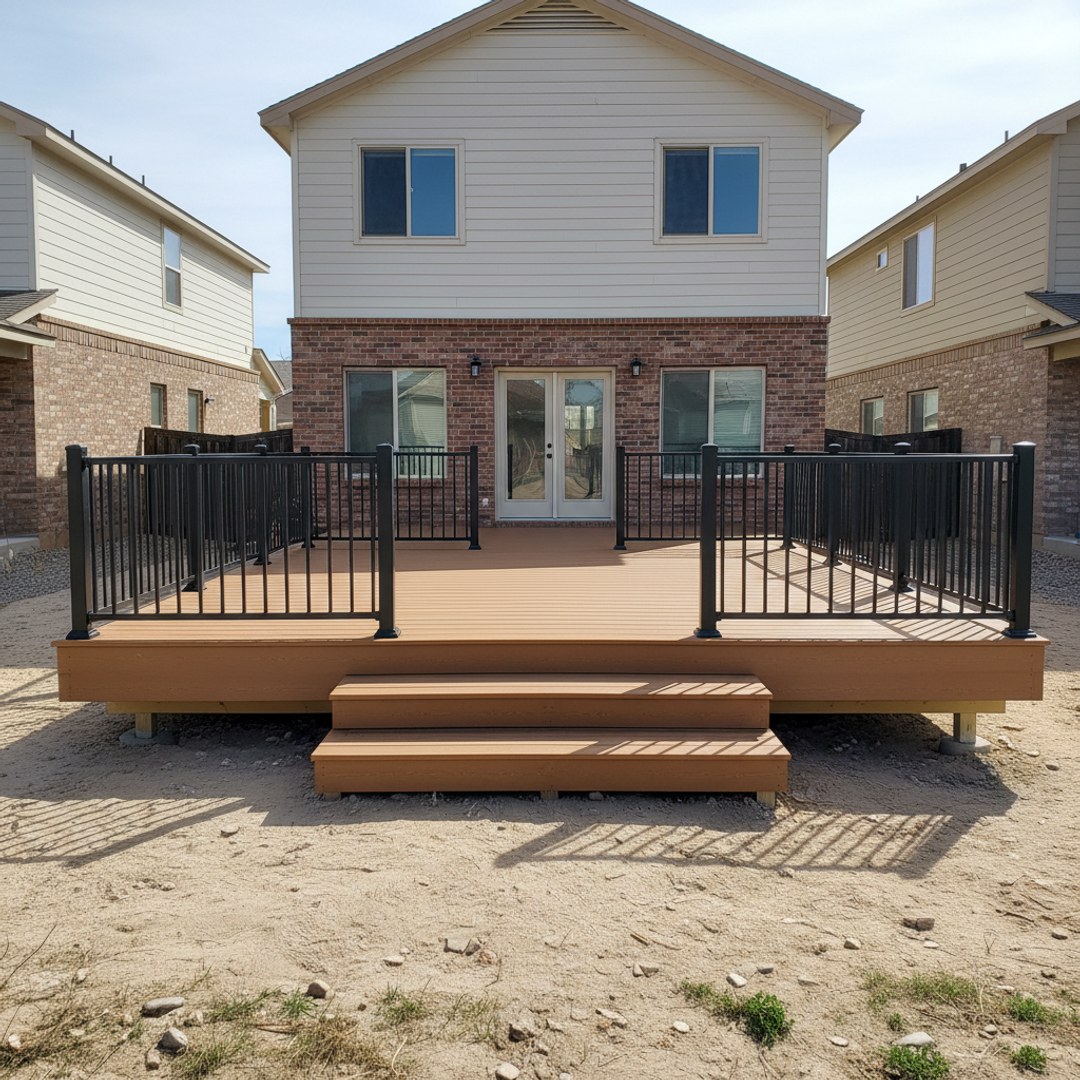
Ask three deck builders in Henderson for a quote and you'll get three different numbers, and it's not because somebody's padding the bill. A deck's price is really five or six separate decisions stacked on top of each other, and most homeowners only know about one or two of them going in.
Material is the biggest lever, and it's not close
Pressure-treated pine framing with a pine or cedar deck board on top is the cheapest way to get a deck under your feet. It's also the one that needs the most upkeep in this climate, which we'll get to. Composite decking (Trex, TimberTech, that family of products) costs more up front, often close to double the material cost of wood per square foot, but it doesn't need staining, doesn't splinter, and holds up better once the sun starts working on it every day from May through September. PVC decking sits above composite in price and is the most stable in heat, which matters more here than it does in a lot of markets.
Framing lumber is the other half of that equation and gets overlooked. Standard pressure-treated joists are fine for most single-level decks. If you're building a second-story deck off a bonus room, or spanning further than a typical 12-foot joist run, you're either upsizing lumber or adding a beam, and that's a cost that shows up before anyone even talks about decking boards.
What's under the deck changes the price before a single board gets cut
This is the part people in Henderson don't expect. A lot of the valley sits on caliche, a hard, cemented layer of calcium carbonate that can start a foot or two down and run thick. Digging a standard footing hole with a hand auger in clean soil takes minutes. Hitting a caliche shelf turns the same hole into a job with a powered auger and sometimes a breaker bar or jackhammer attachment. That's extra labor and extra time on site, and it's the single biggest reason two lots on the same street can come in at different prices for footings alone.
Footing depth here isn't driven by frost the way it is in colder states. We're not digging below a frost line. It's driven by soil bearing capacity and local code minimums, and on a lot of Henderson soil that still means digging past loose fill and reaching something solid enough to carry the load, which is often that same caliche layer working in your favor once you're through it.
Permits and HOA review add time, not drama
Decks over a certain height or attached to the house generally need a permit through the City of Henderson, and that means a plan reviewed for footing size, ledger attachment, and guardrail height before anyone breaks ground. Inspections usually happen at two points: footings before concrete goes in, and framing before the deck boards cover everything up.
Henderson has more HOA communities than most of the Las Vegas valley, think Anthem, Inspirada, MacDonald Highlands, Lake Las Vegas. If you're in one of these, architectural review committee approval typically has to happen before the city permit gets pulled, not after. That can add a few weeks to the timeline. It doesn't usually add cost to the build itself, but it's a step people forget to plan for, and a deck that doesn't match HOA paint or material rules can get flagged after it's already built.
Railing, stairs, and covers aren't optional line items on most decks
Once a deck sits 30 inches or more above grade, code requires a guardrail, and most Henderson lots aren't flat enough to avoid that threshold entirely. Wood baluster railing is the cheapest option. Metal or aluminum balusters cost more but don't warp. Cable rail looks clean and keeps sightlines open, especially nice on a deck looking out at a golf course lot or a view of the Black Mountains, but it costs more in hardware and labor than either of the other two.
Stairs get priced by the step, roughly, because each one needs stringers cut, treads set, and a handrail if there are four risers or more. A deck with a single 4-foot drop to grade is a different stair job than one dropping a full story.
Pergolas and shade covers are their own cost entirely, and in Henderson they're not a luxury add-on so much as a practical one. A deck that faces west with no shade is close to unusable by 2pm in July. A pergola with real coverage, not just lattice, changes whether the deck gets used at all in summer.
Repair, resurfacing, and maintenance costs work differently than new builds
Not every job is a ground-up build. A deck repair often comes down to one of three things: a rotted ledger board where it meets the house, rotted or cracked posts at the footing, or failed fasteners that have worked loose from years of heat expansion and contraction. Fixing a ledger connection properly means pulling boards back, checking flashing, and re-securing with lag bolts rated for the load, not just toe-nailing it back together. That's a few hundred dollars of labor done right, or a bigger bill later if water's been getting behind that ledger for a few seasons without anyone noticing.
Resurfacing, tearing off old decking and railing but keeping sound framing underneath, runs a fraction of a full rebuild if the frame actually checks out. It often doesn't on a deck built before the mid-2000s, especially in older Green Valley neighborhoods where the original structure was built to a lighter spec than current code calls for.
Staining and sealing a wood deck isn't a one-time cost either. Henderson sun is hard on exposed wood, and a stain job that would last four or five years in a milder climate is closer to a two-year job here before it needs reapplying. That's worth factoring into a wood-versus-composite decision at the start, not after you've already built in pine.
There's no single number that covers all of this, because the honest answer is that a deck's price is really the sum of your lot, your material choice, and what the ground does when you start digging. We've priced builds across Henderson and the surrounding towns and walked a lot of backyards to get the number right before a shovel goes in. You can see the range of what we build at Majestic Deck Solutions.